05/08/2026
Construction Jobs Manchester: Salaries, Demand and How to Get Hired in 2026
Construction jobs Manchester employers are advertising have grown substantially over the past few years, driven by large-scale housebuilding, city centre regeneration and one of the busiest logistics and warehouse construction pipelines outside London. Manchester has firmly established itself as the North West's construction hub, offering strong opportunities across every level — from apprentices and skilled trades through to senior commercial and project management roles. This guide walks through what the Manchester construction job market actually looks like in 2026, typical salaries, the areas driving the most demand, and how to position yourself competitively.
Why Manchester Is a Construction Hiring Hotspot
Manchester's construction boom has been building for over a decade, but 2026 sees it accelerating further. The city's skyline continues to transform through major residential towers, mixed-use regeneration schemes around Ancoats, Salford Quays and the wider city centre, alongside continued investment in logistics and industrial development across Trafford Park and the wider Greater Manchester conurbation. Add to that a steady pipeline of public sector infrastructure and transport investment, and the result is a construction labour market with genuinely strong, sustained demand rather than a short-term spike tied to a single project.
Compared with London, Manchester also offers employers a lower cost base, which has attracted regional offices of national contractors and consultancies looking to deliver projects across the North without carrying London-level overheads. For jobseekers, this translates into a wide spread of employer types — from major national contractors to fast-growing regional developers and specialist subcontractors.
Which Construction Roles Are Most in Demand in Manchester
Site Management
Site Managers and Assistant Site Managers remain consistently in demand across Manchester's residential and commercial construction pipeline, particularly candidates with SMSTS certification and experience delivering multi-storey residential schemes.
Quantity Surveying
Manchester's quantity surveyor shortage mirrors the national picture, with strong demand at both assistant and senior level across contractors, consultancies and developers managing the city's ongoing regeneration projects.
Skilled Trades
Bricklayers, groundworkers, carpenters and electricians remain some of the highest-volume vacancies in Manchester, reflecting the sheer scale of residential construction currently underway across the city and wider Greater Manchester.
Civil Engineering
Civil engineers are in strong demand across Manchester's transport, utilities and infrastructure projects, with particular need for candidates experienced in highways, drainage and groundworks design.
Design and BIM Coordination
As more Manchester contractors adopt digital construction workflows, BIM Coordinators and Digital Construction Managers have become an increasingly visible and well-paid specialism within the city's larger contracting firms.
Manchester Construction Salary Expectations
Manchester construction salaries typically sit below London rates but go considerably further given the lower cost of living, particularly housing. As a general guide:
- Apprentices and trainees: roughly £18,000–£24,000
- Skilled trades (bricklayers, carpenters, electricians): roughly £30,000–£42,000, with experienced tradespeople and those running their own crews earning more
- Assistant Quantity Surveyors / Assistant Site Managers: roughly £28,000–£36,000
- Quantity Surveyors / Site Managers: roughly £40,000–£58,000
- Senior Quantity Surveyors / Senior Site Managers: roughly £58,000–£75,000
- Commercial Managers / Project Managers: roughly £65,000–£90,000+
Specialist roles — particularly civil engineering, BIM leadership and senior commercial management — regularly command salaries at the top of, or above, these ranges, especially within larger national contractors operating in the city.
Top Areas Driving Construction Demand in Manchester
- Ancoats and New Islington — high-density residential regeneration
- Salford Quays and MediaCityUK — mixed-use commercial and residential development
- Trafford Park — one of the UK's largest logistics and industrial construction pipelines
- Manchester City Centre — continued high-rise residential and commercial towers
- Wider Greater Manchester — housebuilding across boroughs including Stockport, Bolton and Wigan
Many roles based in central Manchester also involve travel across the wider Greater Manchester region, so it's worth confirming site locations and travel expectations during the application process rather than assuming a fixed city-centre base.
Skills That Make You More Competitive in Manchester
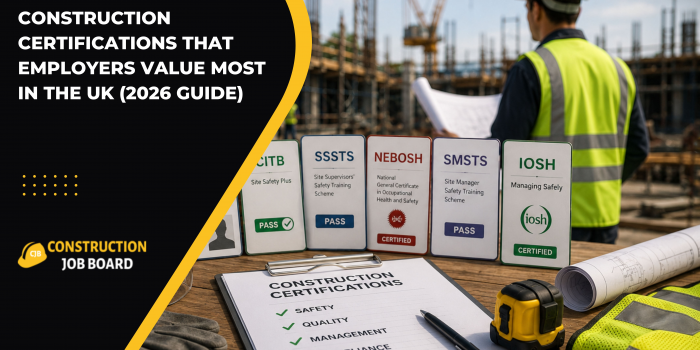
- CSCS card — a baseline requirement for the overwhelming majority of site-based roles across Manchester's construction sector.
- SMSTS or SSSTS — increasingly expected for supervisory and management-level roles, even at assistant level.
- Digital construction familiarity — experience with BIM software or project management platforms is increasingly valued, even for site-based roles.
- NEC or JCT contract knowledge — particularly valuable for commercial and quantity surveying roles working across Manchester's larger regeneration schemes.
- Multi-trade flexibility — tradespeople comfortable working across more than one discipline are consistently in stronger demand given current skills shortages.
How to Find Construction Jobs in Manchester Effectively
- Use a specialist construction job board with location filtering, rather than relying solely on general job sites where construction roles can get buried among unrelated vacancies.
- Register your CV directly with construction-focused recruitment agencies operating across the North West, many of which have early access to vacancies before they're publicly advertised.
- Set up targeted job alerts for Manchester-specific roles so you can apply quickly once relevant vacancies go live.
- Keep certifications current — an up-to-date CSCS card, relevant NVQ level, and any specialist tickets should be clearly listed on your CV and ready to provide during the application process.
- Consider contract as well as permanent roles — Manchester's active project pipeline means contract and freelance opportunities are widely available and can offer a faster route into higher-demand projects.
Working Patterns and Site-Based Considerations
Unlike many office-based industries, construction roles in Manchester remain predominantly site-based, though commercial, design and project support roles increasingly offer hybrid arrangements combining site visits with office or remote working. If flexibility matters to you, it's worth clarifying the specific working pattern during interviews, since expectations vary significantly between site-based operational roles and office-based commercial or design positions.
The Skills Shortage and What It Means for Jobseekers
Manchester, like the rest of the UK, continues to face a genuine construction skills shortage, particularly in quantity surveying, site management and several skilled trades. For jobseekers, this creates real leverage — candidates with in-demand certifications and demonstrable experience are often able to negotiate stronger packages than in more saturated job markets, and many employers are increasingly open to supporting further training and qualifications for the right candidates.
Common Mistakes Jobseekers Make in Manchester
Even with strong overall demand, some candidates struggle to convert applications into offers. A few recurring issues stand out:
- Letting certifications lapse. CSCS cards, SMSTS refreshers and other tickets have expiry dates, and employers routinely reject otherwise strong candidates whose paperwork isn't current at the point of application.
- Applying without confirming site location. Manchester construction roles often involve travel across Greater Manchester rather than a fixed city-centre site, and candidates who don't confirm this upfront sometimes withdraw late in the process once travel expectations become clear.
- Underselling multi-trade experience. Tradespeople who can competently work across more than one discipline often undersell this on their CV, missing out on roles that specifically value flexibility given current skills shortages.
- Not researching the employer's specific project type. Manchester's construction market spans residential towers, logistics warehousing and heritage-adjacent regeneration — tailoring your application to the specific project type an employer is delivering noticeably improves response rates.
What Employers in Manchester Are Looking For
Beyond core trade or professional qualifications, Manchester employers consistently highlight a few additional qualities during recruitment. Reliability and punctuality remain highly valued on fast-moving residential and logistics projects where delays carry real commercial cost. Employers also increasingly favour candidates who can demonstrate awareness of health and safety best practice beyond the minimum certification requirement, reflecting continued regulatory focus across the sector. For commercial and management roles, familiarity with digital reporting tools and basic data literacy is becoming a differentiator, even outside dedicated digital construction positions.
Final Thoughts
Manchester offers one of the strongest and most sustained construction job markets in the UK outside London, combining a genuinely diverse project pipeline with a lower cost of living. Whether you're an apprentice starting out, a tradesperson looking for consistent work, or a commercial professional targeting career progression, Manchester's continued regeneration and housebuilding activity means strong, ongoing demand across nearly every construction specialism.
Frequently Asked Questions
What is the average construction salary in Manchester?
Skilled trades in Manchester typically earn between £30,000 and £42,000, while Quantity Surveyors and Site Managers commonly earn £40,000–£58,000, with senior commercial roles reaching £65,000–£90,000 or more.
Do I need a CSCS card for construction jobs in Manchester?
Yes, a valid CSCS card is required for the vast majority of site-based construction roles in Manchester, and is typically the first qualification employers check for during recruitment.
Which areas of Manchester have the most construction jobs?
Ancoats, Salford Quays, Trafford Park and the wider Manchester city centre are among the strongest areas for current construction demand, alongside housebuilding activity across the wider Greater Manchester boroughs.
Is Manchester a good alternative to London for construction careers?
Yes. Manchester offers strong, sustained construction demand with a significantly lower cost of living than London, making it an increasingly attractive base for both tradespeople and commercial construction professionals.
What construction roles are hardest to fill in Manchester?
Quantity Surveyors, Site Managers, bricklayers, groundworkers and electricians are consistently among the hardest roles to fill in Manchester, reflecting the broader UK-wide construction skills shortage.
How can I find construction jobs in Manchester quickly?
Using a specialist construction job board with location filters, registering with North West recruitment agencies, and setting up targeted job alerts are the most effective ways to surface relevant Manchester vacancies quickly.